
A Florentine Vision in the Heart of London: 100 Years of Chelsea Studios
An Enclave for Artists
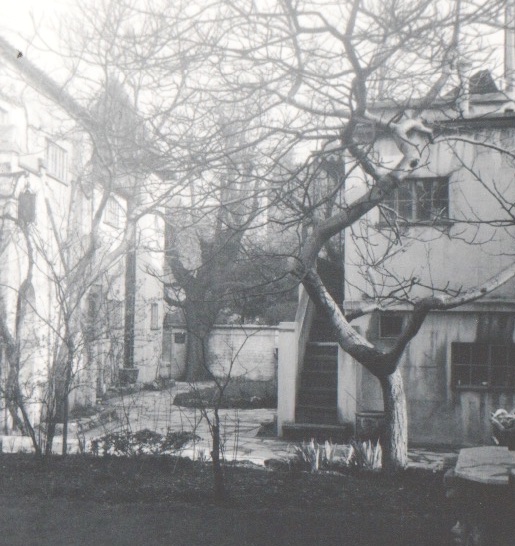
Tucked away behind the bustling Fulham Road in a gated complex, Chelsea Studios has been a hidden enclave for artists and their creative brilliance. Developed and expanded in the 1920s, it was the vision of Italian sculptor-architect Mario Manenti. Since then, this picturesque retreat has quietly housed some of the most fascinating figures in London’s fine art and fashion scenes. Despite its understated presence, Chelsea Studios has played a significant role in nurturing London’s creative scene and housed artists’ circles and gatherings.
The Vision of Mario Manenti
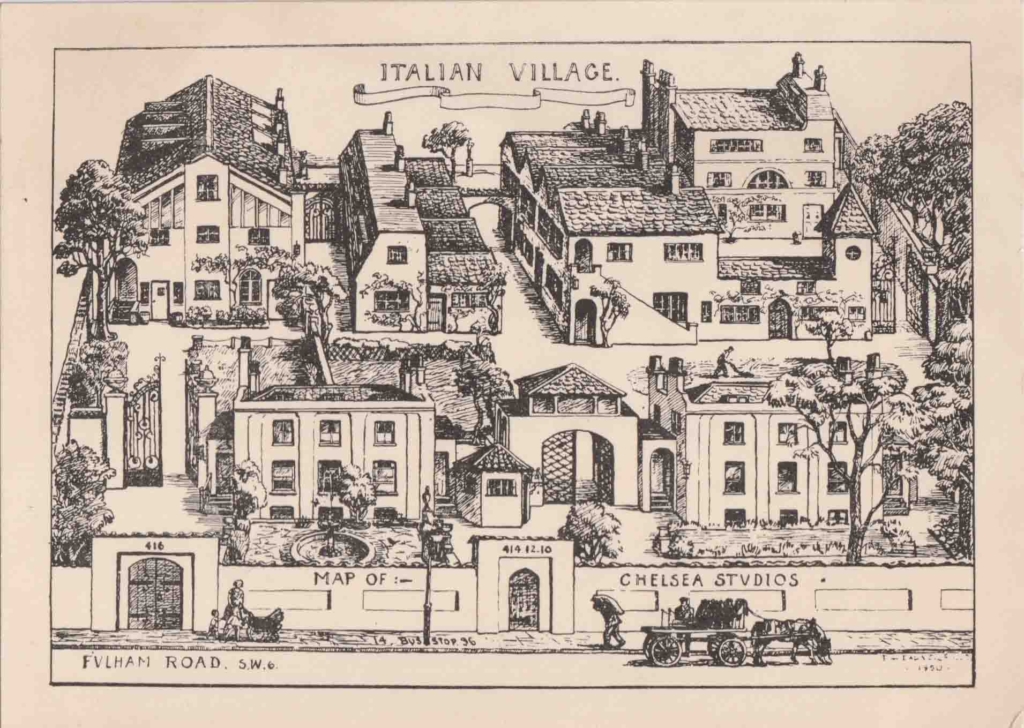
Mario Manenti designed Chelsea Studios around his foundry, which he took over from Frederick Mancini in 1921. In this space, he cast notable works such as World War I memorial sculptures. Later, he expanded the site to create an art studio complex for a close-knit community of artists. Inspired by his estate in Florence, the studios later became known as “the Italian Village.” This marked the beginning of many stories of creative residents who would go on to shape London’s art and fashion scenes.
A Hub for London’s Artists
In the 1930s and 1940s, the sculptor Feridah Forbes lived at Chelsea Studios, fostering an artistic, salon-like atmosphere. Her daughter, Juanita Forbes (b. 1929), grew up surrounded by artists and “lots of art of all descriptions.” Feridah’s connections brought eminent figures to Chelsea Studios, including the sculptor Sir Jacob Epstein (1880–1959). He later created portrait sculptures of Juanita on-site.
Through another resident artist, Timothy Whidborne, Juanita was introduced to the Italian painter Pietro Annigoni. Before Annigoni’s royal commissions, he painted Juanita’s portrait in 1953 while she sat for him at Chelsea Studios. His association with the studios further strengthened their reputation in London’s art community. Annigoni, named by Sir Alfred Munnings as the “best portrait painter of the 20th century,” was known for his use of Italian Old Master techniques.
The Creative Residents of the 1950s and 60s
By the 1950s and 60s, Chelsea Studios had become home to rising stars of London’s creative scene. Joseph Keenan (also known as Derek Ashley), co-founder of the Green Park Open Air Exhibition, bought a studio in the complex and lived there until 1986. Fashion photographer David Hurn and the model-turned-editor Grace Coddington were neighbours at Chelsea Studios, living in flats next to each other. Pattie Boyd’s memoir recalls that in the early 1960s, “[Erick Swayne] lived in a flat in Chelsea Studios… with the photographer David Hurn next door. Grace Coddington… had the flat above.”
The presence of these figures made the enclave a quiet epicenter of Swinging London’s art and fashion circles. Over the years, numerous painters, sculptors, writers, and performers have called Chelsea Studios home; so much so that in its mid-century heyday one had to be an artist to buy a place there.
In recent decades the rule has relaxed, but creative residents remain. Contemporary artist Suzy Murphy, for example, purchased a unit and converted it back into a working art studio in the 2010s. Murphy’s spacious studio-home, with its double-height ceilings and north-light windows, allowed her to paint large-scale landscapes and even host friends like the late writer A.A. Gill for life-drawing sessions. Such residents carry on the artistic spirit of the place into the 21st century.

Sources: Historical archives, news articles, and resident interviews have been used to compile this article, including The Independent (the-independent.com), Tatler (tatler.com), local conservation documents (lbhf.gov.uk), and personal memoirs (archive.org).

© Copyrights www.derekashleyart.uk | All Rights Reserved